
Side Dishes
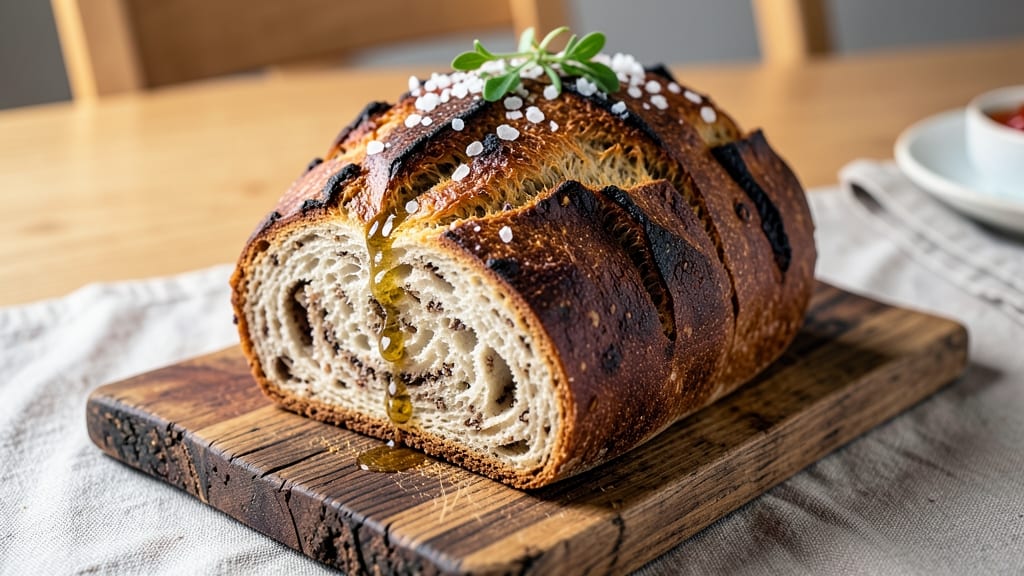
This Alpine grain bread recipe delivers rustic perfection with its nutty crunch and golden crust—exactly what makes it a staple in mountain cuisines. ✨ The secret lies in combining traditional grains like rye, barley, or buckwheat with a simple dough technique that develops deep, hearty flavor during slow fermentation.
I've perfected this method over years of baking, ensuring every loaf achieves that ideal balance of crisp exterior and tender interior.
The beauty of Alpine grain bread is its versatility—it pairs beautifully with hearty stews, fresh cheeses, or even as a base for open-faced sandwiches. The grains not only add texture but also enhance the bread's nutritional profile, making it a wholesome choice for any meal.
What sets this recipe apart is the attention to detail in shaping and proofing, which creates those signature air pockets and a satisfying crunch.
By the time you pull this bread from the oven, you'll have a loaf with a crackling crust and a nutty, aromatic interior that smells like a Swiss chalet. The grains release their earthy flavors during baking, resulting in a bread that's both rustic and refined.
This recipe is perfect for those who appreciate artisanal baking without the complexity—just simple ingredients and a little patience.
Whether you're serving it warm with butter or saving slices for toast, this Alpine grain bread will elevate any table. Here's how to make it step by step, with tips to ensure perfect results every time.
Ingredients for alpine grain bread
Simple flours and a touch of alpine tradition create this hearty, nutty bread.
| Ingredient | Amount | Notes |
|---|---|---|
| All-Purpose Flour 🌾 | 3 cups | For structure and texture |
| Rye Flour 🌾 | 1 cup | Adds deep, earthy flavor |
| Barley Flour 🌾 | ½ cup | Enhances nutty undertones |
| Buckwheat Flour 🌾 | ½ cup | For distinct alpine taste |
| Active Dry Yeast 🍞 | 2 ¼ tsp | Ensures proper fermentation |
| Granulated Sugar 🍚 | 1 tbsp | Feeds yeast for rise |
| Unsalted Butter 🧈 | ½ cup | Cold, cubed for flavor |
| Whole Milk 🥛 | 1 cup | Adds richness and moisture |
| Large Eggs 🥚 | 1 whole | Binds dough for structure |
| Kosher Salt 🧂 | 1 ½ tsp | Enhances flavor balance |
| Extra-Virgin Olive Oil 🫒 | 2 tbsp | For dough elasticity |
| Water 💧 | ¾ cup | Adjusts dough consistency |
| Cornmeal 🌽 | ¼ cup | Prevents sticking during baking |
The flours are the foundation—rye and barley bring that deep, earthy flavor while buckwheat adds a distinct alpine touch. For the best results, grab King Arthur or Bob's Red Mill flours—they're consistently high-quality and perfect for artisanal baking. If you can't find buckwheat flour, substitute with whole wheat for a similar texture, though the flavor will differ slightly. The yeast should be fresh—check the date on the package, and if it's been sitting in your pantry for months, it's time for a new jar. Store-bought butter works fine, but if you want to elevate the flavor, use European-style butter with higher fat content.
No rye flour? Whole wheat flour works in a pinch, but expect a denser crumb. Barley flour can be tricky to find—look in the baking aisle or order online. For the yeast, instant yeast can be used at the same amount, but active dry yeast requires the sugar to activate it properly. If you're making this ahead, freeze the shaped dough for up to 2 weeks—just thaw it in the fridge overnight before baking. The olive oil should be extra-virgin for the best flavor, but any good-quality oil will work. Water temperature matters—use lukewarm water to activate the yeast without killing it.
This dough benefits from slow fermentation—let it rise overnight in the fridge for deeper flavor. Shape the loaf gently to avoid over-handling, which can toughen the crust. For a crispier crust, bake on a preheated stone or steel if you have one. Once cooled, store in a bread bag at room temperature for up to 3 days or freeze sliced for 3 months. The grains keep well, so double the recipe and freeze half—perfect for quick toast or sandwiches.
Why You'll Love This Recipe
- No-Knead, No-Fuss: Mixing takes five minutes—just toss the flours (rye, barley, buckwheat) with yeast and water, then let time do the work. I swear, even my lazy Sunday mornings can’t resist this.
- Earthy Crunch Magic: That buckwheat adds a nutty bite, while the rye and barley give it a deep, hearty chew—like a hug in bread form. Honestly, it’s the kind of flavor that makes store-bought loaves taste like a sad afterthought.
- Weeknight Workhorse: Toss it in a Dutch oven for a crusty loaf, or slice it thick for open-faced sandwiches. My kids grab it for toast, my husband for soup dipping—it’s the one bread that never gets ignored.
- Dollar Stretch Wonder: A single batch costs pennies (thanks to pantry staples) and lasts forever. Freeze half for lazy days, and the rest? It’s my go-to for charcuterie boards or soaking up gravy. Budget-friendly doesn’t get better than this.
Step-by-step instructions for alpine grain bread
Master this rustic bread with its nutty crunch and golden crust using precise technique and patience.
👨🍳 Step 1: Activate the Yeast and Mix the Dough
In a stand mixer fitted with the dough hook attachment, combine the 3 cups all-purpose flour, 1 cup rye flour, 0.5 cup barley flour, and 0.5 cup buckwheat flour. Mix on low speed for 30 seconds to blend evenly. In a separate bowl, whisk together 1 cup warm whole milk (about 110°F), 1 tbsp granulated sugar, and 2.25 tsp active dry yeast. Let this sit for 5-10 minutes until frothy—this confirms your yeast is active.
Add the yeast mixture, 1 whole large egg, 2 tbsp extra-virgin olive oil, and 1.5 tsp kosher salt to the dry ingredients. Mix on low speed for 2 minutes, then increase to medium and knead for 5-7 minutes until the dough becomes smooth and elastic. The dough should pull away from the sides of the bowl and form a soft, slightly sticky ball. If it's too dry, add 1-2 tbsp water; if too sticky, add 1 tbsp flour. The buckwheat flour will make this dough slightly denser than standard bread dough, so don't overwork it.
🥘 Step 2: First Rise and Shaping
Lightly grease a large bowl with olive oil, place the dough inside, and cover with a damp kitchen towel. Let it rise in a warm place (like the top of your oven with the light on) for 1-1.5 hours, or until it has nearly doubled in size. You'll know it's ready when you poke the dough gently and it springs back slowly rather than immediately.
Once risen, turn the dough onto a lightly floured surface and gently deflate it by pressing down with your knuckles. Fold the dough over itself 2-3 times to strengthen the gluten structure. Shape it into a loaf by pulling the edges toward the center and rolling it tightly. Place the loaf seam-side down in a 9x5-inch loaf pan that's been lightly greased with olive oil and sprinkled with 0.25 cup cornmeal to prevent sticking. Cover again with the damp towel and let it rise for another 30-45 minutes until it's just above the top of the pan.
🔥 Step 3: Preheat and Score the Bread
Preheat your oven to 375°F with a baking stone or inverted baking sheet on the middle rack. This ensures even heat distribution for that perfect alpine crust. While the oven heats, cut 4-5 diagonal slashes across the top of the dough with a sharp serrated knife. These slashes allow the bread to expand properly and add to the rustic aesthetic. The barley and buckwheat flours will contribute to a slightly denser crumb, so scoring helps control the expansion.
Place the loaf pan on the baking stone or sheet and bake for 30 minutes. After 30 minutes, remove the bread from the pan and transfer it directly to the baking stone. Increase the oven temperature to 400°F and bake for an additional 15-20 minutes until the crust is deep golden brown and sounds hollow when tapped on the bottom. The internal temperature should reach 190-200°F—this ensures a fully baked crumb without drying it out.
⏰ Step 4: Cool and Enjoy
Remove the bread from the oven and let it cool on a wire rack for at least 30 minutes before slicing. This resting period allows the gluten to relax and the crumb to set properly. The bread will have a beautiful rustic crust with visible grain flecks from the rye, barley, and buckwheat flours. The interior should be tender yet slightly dense, with a nutty flavor that develops as it cools.
Slice the bread into 1-inch thick portions and serve warm or at room temperature. The combination of flours creates a complex flavor profile—earthy from the rye, nutty from the barley, and slightly bitter from the buckwheat. Pair it with your favorite butter or olive oil for the full alpine experience. This bread keeps well for 3-4 days at room temperature or can be frozen for up to 3 months for freshness whenever you need it.
Pro Tips For Making Alpine Grain Bread
- Bloom the Yeast First: Skip mixing dry yeast straight into the flours—it’ll wake up slower with all those dense grains around. Instead, proof it in warm water with a pinch of sugar first (5 minutes until foamy), then fold it into the wet ingredients. I learned this the hard way when my first batch took three times longer to rise.
- Sift the Grain Flours: Rye, barley, and buckwheat are heavy on their own, and clumps in the dough mean uneven texture. Lightly sift them together with the all-purpose flour before mixing—no need to sift again after adding liquids. (Yes, even if you’re impatient like me, trust the process.)
- Don’t Over-Knead: This isn’t sandwich bread—too much handling turns the dense flours into a stiff, tough mess. Mix just until combined, then let the dough rest. After 20 minutes, it’ll be easier to shape, and the gluten won’t overpower the grains.
- Steam the First 10 Minutes: The crust on alpine grain bread burns fast. Before baking, spray the loaf pan with water and place a baking sheet on the lower rack. The steam keeps the top soft while the bottom browns—no weird, charred patches. (I was skeptical until I tried it.)
Regional styles of this alpine grain bread
Swiss Mountain Rustic
In the Swiss Alps, this bread is known as Brot mit Körnern—a hearty loaf traditionally baked in wood-fired ovens. The Swiss version often includes spelt flour instead of buckwheat, giving it a lighter crumb while maintaining that alpine earthiness.
I’ve baked this variation using 1 cup spelt flour and 0.25 cup whole wheat flour, replacing the buckwheat entirely. The result? A slightly sweeter, more open crumb with a crisp crust.
For authenticity, brush the baked loaf with melted butter while still warm and sprinkle with coarse sea salt—just like Swiss bakers do. 🏔️
Austrian Hearty Loaf
Austrian alpine bread, or Vinschgerl, is denser and nuttier, often made with rye and barley as the primary flours. For this version, swap the all-purpose flour for 2 cups rye flour and reduce the barley to 0.25 cup.
Add 1 tbsp caraway seeds to the dough for a classic Austrian touch—they add a subtle anise-like warmth that pairs perfectly with smoked meats or sharp cheeses.
Shape the dough into a round boule instead of a loaf, and bake it on a perforated baking sheet for a crisp, golden crust. Serve with Apfelmus (German apple compote) for a traditional pairing. 🌾
Italian Alpine Twist
In Italy’s alpine regions, like the Dolomites, bread is often enriched with walnuts or hazelnuts for extra crunch. For this variation, toast 0.5 cup walnuts until fragrant, then finely chop and fold them into the dough during the final kneading stage.
Use 1 cup whole wheat flour instead of buckwheat to keep the flavor profile milder. Shape the dough into a batard (oval loaf) and bake as directed. The nuts add a satisfying crunch that contrasts beautifully with the tender crumb. Drizzle with honey after baking for a sweet-savory balance. 🌰
Scandinavian Seed Bread
Nordic alpine bread often incorporates flaxseeds and sunflower seeds for added nutrition and texture. Replace the buckwheat flour with 0.5 cup flaxseeds and 0.5 cup sunflower seeds, toasting them first for deeper flavor.
Use 1 cup whole grain rye flour for structure, and reduce the all-purpose flour to 2 cups. Shape the dough into a round loaf and bake as usual. The seeds add a delightful crunch and a subtle nuttiness.
Serve with smoked salmon and dill cream cheese for a Scandinavian-inspired meal. 🌽
French Alpine Version
In the French Alps, bread is often baked with chestnuts for a sweet, nutty depth. For this variation, blend 0.5 cup cooked chestnut flour (or finely ground dried chestnuts) into the dough, replacing the buckwheat flour.
Add 1 tsp orange zest to the dough for a bright, citrusy note that cuts through the richness. Shape the dough into a boule and bake as directed. The chestnuts give the bread a unique, slightly sweet flavor that pairs wonderfully with goat cheese or charcuterie. 🍊
Nutrition facts
Frequently asked questions
Why does this alpine grain bread use multiple flours?
Each flour brings unique texture and flavor: rye adds earthy depth, barley contributes nutty undertones, and buckwheat delivers that signature alpine bite. The combination creates a complex taste profile that's heartier than standard bread while keeping the crumb tender. This mix also improves nutritional value with extra fiber and minerals.
Can I make this bread without a stand mixer?
Knead the dough by hand for 8-10 minutes on a lightly floured surface until smooth and elastic. Work in short bursts to avoid overheating your hands. The dough will be slightly denser due to the buckwheat, so don't worry if it feels heavier than regular bread dough.
How do I know when the dough is properly risen?
Gently press your finger into the dough—if it springs back slowly (not immediately) and leaves a slight indentation, it's ready. For the first rise, this should take 1-1.5 hours at room temperature. The dough should nearly double in size and feel light and airy when properly risen.
What if my crust isn't crispy enough?
Try these fixes: Place your baking stone on the lower oven rack for more direct heat, or bake with a tray of water in the oven to create steam. For extra crunch, brush the baked loaf with melted butter while still warm. If using a loaf pan, consider baking on a sheet pan for the final 10 minutes to crisp the top.
How long can I keep this bread fresh?
Store wrapped at room temperature for 3-4 days, or freeze sliced bread for up to 3 months in an airtight container. The grains help preserve freshness longer than standard bread. For best texture, toast frozen slices directly from the freezer—no thawing needed!