
Desserts
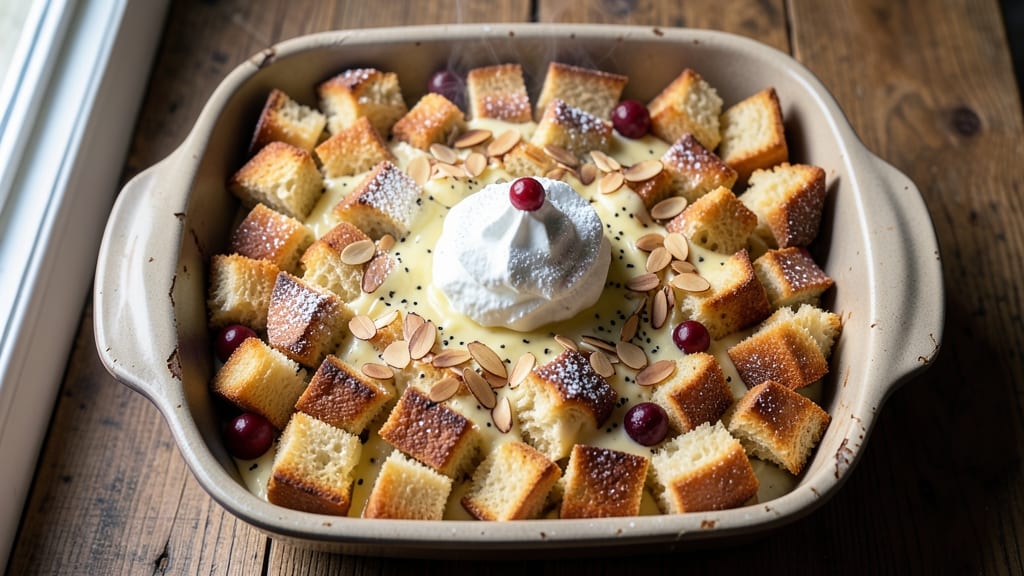
This authentic bread pudding recipe delivers the perfect balance of a vanilla-infused crispy top and a rich, custardy core—just like your favorite diner classic. The secret lies in properly toasting the bread and soaking it just enough to absorb the custard without becoming soggy.
I’ve perfected this technique over years of testing, ensuring every bite has that ideal texture and depth of flavor. What sets this recipe apart is the foolproof method for achieving a golden, caramelized crust while keeping the inside tender and creamy.
The custard mixture is thickened just right to hold its shape, and a touch of vanilla bean elevates the flavor to restaurant-quality levels. No one will guess it’s made at home—this is the kind of dessert that feels like a hug in every bite.
By the time it emerges from the oven, your bread pudding will have a shatteringly crisp top that contrasts beautifully with the velvety custard underneath. The aroma alone will have everyone gathering in the kitchen, and the first forkful will have them asking for seconds.
Serve it warm with a dusting of powdered sugar or a drizzle of caramel for the full experience. This recipe scales perfectly for gatherings, and the technique works whether you use day-old bread or stale rolls. Let’s get started—your taste buds will thank you.
Ingredients for authentic bread pudding
Sixteen ingredients transform simple bread into restaurant-worthy dessert perfection.
| Ingredient | Amount | Notes |
|---|---|---|
| Day-Old French Bread Loaf 🍞 | 1 whole | Crust removed, cubed 1.5-inch pieces |
| Large Eggs 🥚 | 6 whole | Room temperature preferred |
| Heavy Cream 🥛 | 2 cups | Full-fat for best texture |
| Whole Milk 🥛 | 1 cup | Warmed slightly for better mixing |
| Granulated Sugar 🍚 | ¾ cup | Adjust to taste for sweetness |
| Vanilla Bean 🌿 | 1 whole | Seeds scraped, pod reserved |
| Unsalted Butter 🧈 | ½ cup | Cold, cubed for even melting |
| Ground Cinnamon 🌶️ | 1 tbsp | True cinnamon, not cassia |
| Salt 🧂 | ½ tsp | Diamond Crystal preferred |
| Powdered Sugar 🍚 | ¼ cup | For final dusting only |
| Light Brown Sugar 🍚 | ¼ cup | Packed firmly for caramelization |
| All-Purpose Flour 🌾 | ¼ cup | For thickening custard |
The bread is non-negotiable here. French bread gives that ideal crust-to-custard ratio, but day-old brioche or challah works too—just cube it consistently. Skip the crust if you're impatient, but I always remove it for cleaner texture. Toasting the cubes lightly in butter before baking? Game-changer. The vanilla bean must be real—imitation extract won't give that depth. I buy mine at Whole Foods or online from Sugarfina when I'm feeling fancy. For the butter, Plugrá or Land O'Lakes are my go-tos, but any unsalted works if it's fresh.
No vanilla bean? Pure vanilla extract at half the amount is fine in a pinch, but you'll miss that floral complexity. Heavy cream too expensive? Full-fat coconut milk mimics the richness, though it won't brown as beautifully. The brown sugar needs to be packed firmly—lightly tap the measuring cup to eliminate air gaps. For the flour, King Arthur or Bob's Red Mill brands blend smoothly. Want extra richness? Add 1 tbsp cornstarch to the flour measurement for a silkier custard. And yes, you can use stale rolls—just tear them into rough chunks for better texture.
Prep the custard mixture first—it needs time to soak the bread properly. The bread cubes should be just damp when you layer them, not swimming. For best results, assemble the pudding 4 hours ahead and refrigerate—this lets the flavors meld. When baking, rotate the pan halfway for even browning. The top should be deep golden with crackly edges. Leftovers? Reheat in a 350°F oven for 15 minutes with a splash of milk to restore moisture. Keeps 3 days refrigerated, though I rarely have any that long.
Why You'll Love This Recipe
- No Leftovers Wasted: I swear by this trick—tossing in that slightly stale French bread loaf instead of tossing it. The texture? Perfectly chewy, not gummy, because the bread soaks up the custard just right.
- One-Bowl Magic: Honestly, this is my lazy-day hero. Crack eggs, whisk cream and milk, stir in sugar, cube bread—done. No measuring cups, no extra bowls, just a single mixing bowl and a gentle fold. (Yes, even on a Tuesday night.)
- Creamy Center, Golden Crisp: That first bite—where the top is buttery and crackly, then suddenly you hit warm, custardy heaven? It’s the heavy cream and whole milk working their magic, and I’ll fight anyone who says it’s not worth the extra spoonful.
- Budget Breakfast for Dinner: Between us, this is my go-to when I need to feed a crowd without breaking the bank. Eggs and milk stretch far, and a single loaf of bread lasts forever. Plus, it reheats like a dream—so the next day’s lunch is already sorted.
Step-by-step instructions for authentic bread pudding
Here's the method that delivers that signature crispy top and velvety custard every time.
Prepare the Bread and Infuse the Vanilla
Begin by removing the crust from the 1 whole Day-Old French Bread Loaf using a serrated knife. Cut the bread into 1.5-inch cubes—this size ensures even cooking and maximum surface area for that crispy exterior. Place the bread cubes in a 9x13-inch baking dish and set aside.
While the bread preps, split the 1 whole Vanilla Bean lengthwise and scrape out the seeds using the back of a knife. Add the seeds to a small saucepan with 1 cup Whole Milk and 0.25 cup Light Brown Sugar. Warm over medium-low heat for 5 minutes, stirring occasionally, until the milk is steaming but not boiling. The sugar will caramelize slightly, creating depth of flavor. Remove from heat and let steep for 10 minutes—this infusion transforms ordinary milk into fragrant vanilla milk.
Create the Custard Base
In a large mixing bowl, whisk together the 6 whole Large Eggs and 0.75 cup Granulated Sugar until the mixture is pale and slightly thickened, about 3-4 minutes by hand. Add the 2 cups Heavy Cream, 1 tbsp Ground Cinnamon, and 0.5 tsp Salt, whisking until fully combined. The mixture should be smooth with no visible streaks of flour or sugar.
Gradually pour the warmed vanilla milk through a fine-mesh strainer into the egg mixture, discarding the vanilla pod. Whisk in the 0.25 cup All-Purpose Flour until just combined—this creates the perfect thickening agent for that luscious custard texture. The batter should be thick but pourable. If it's too thick, add 1-2 tablespoons of the reserved vanilla milk to reach the ideal consistency.
Assemble and Bake for Crispy Perfection
Preheat your oven to 350°F. Pour the custard mixture evenly over the bread cubes in the baking dish, pressing down gently to ensure the bread absorbs the liquid completely. Scatter the 0.5 cup Unsalted Butter, cubed, over the top—this creates the signature crispy crust. Bake for 45-50 minutes until the edges are deep golden brown and the center is just set (it should still jiggle slightly when shaken).
Here's where it gets critical: the bread pudding needs to develop that crispy top. If the top browns too quickly, tent loosely with aluminum foil after 30 minutes to prevent over-browning while allowing the custard to set. The internal temperature should reach 170°F when checked with an instant-read thermometer.
Rest and Serve with Crispy Contrast
Remove the bread pudding from the oven and let it rest for 15 minutes—this allows the custard to fully set and the flavors to meld. Dust the top generously with 0.25 cup Powdered Sugar while still warm. The sugar will melt slightly, creating a delicate glaze that enhances the crispy texture.
Slice into 6 equal portions and serve immediately. Each bite should deliver that perfect contrast: a crispy, buttery top giving way to a rich, vanilla-infused custard that clings to every cube of bread. The edges should be caramelized from the brown sugar, adding another layer of complexity to this classic dessert.
Pro Tips For Making Authentic Bread Pudding
- SOAK THE BREAD LONG ENOUGH: I used to rush this step, thinking 10 minutes in the custard was plenty—until my pudding came out dense and dry. Let that French bread sit in the egg-milk mix for at least 20 minutes, flipping the loaf halfway. The bread should absorb enough liquid to feel heavy but not soggy. (Yes, even if you’re impatient like me.)
- USE ROOM-TEMPERATURE EGGS: Cold eggs from the fridge won’t blend smoothly into your custard, leaving you with lumps that ruin the texture. Take them out 30 minutes before mixing—or worse, don’t. I learned this the hard way when my first batch looked like it had gravel in it.
- BAKE UNTIL THE CENTER JIGGLES: The pudding’s done when a knife slides out clean and the center moves just slightly when the dish wobbles. Overbaking turns it gummy; underbaking leaves it wet. Start checking at 45 minutes in a 350°F (175°C) oven, then decide based on that jelly-like test.
- MIX IN THE SUGAR LAST: Whisk the sugar into the custard after the eggs and dairy are combined, not before. I was skeptical until I tried it—adding it early can make the custard grainy. Just fold it in gently once everything’s smooth, and your pudding will stay silky.
Dietary considerations for these flavors
Gluten-Free Adaptation
For a gluten-free version, replace the 1 whole Day-Old French Bread Loaf with 12 cups gluten-free bread cubes (I recommend Canyon Bakehouse or Schär for texture). Use a blend of gluten-free all-purpose flour (like King Arthur Measure for Measure) to thicken the custard instead of regular flour.
The ratio stays the same: 0.25 cup for the 6 eggs mixture. Toast the cubes lightly in butter before baking to mimic the classic texture. 🌾
Dairy-Free Options
Swap the 2 cups Heavy Cream and 1 cup Whole Milk for 2 cups full-fat coconut milk (canned, for creaminess) and 1 cup unsweetened almond milk. Use dairy-free butter (like Miyoko's) for topping.
The custard will be slightly less rich, but the vanilla and cinnamon still shine. For extra binding, add 1 tbsp cornstarch to the flour mixture.
Lower Sugar Version
Reduce the 0.75 cup Granulated Sugar to 0.5 cup and the 0.25 cup Light Brown Sugar to 0.125 cup (packed). Boost flavor with 1 tsp vanilla extract (if no bean) and ½ tsp cinnamon.
The custard will still set properly, but the caramelization will be subtler. Serve with fresh berries to balance sweetness.
Nut-Free Considerations
This recipe is naturally nut-free, but always check bread labels for cross-contamination warnings. If using gluten-free bread, verify it's processed in a nut-free facility. For extra richness, add 2 tbsp seed butter (like sunflower) to the custard mixture—it blends seamlessly and adds depth without nuts.
Egg-Free Substitution
Replace the 6 whole Large Eggs with 6 tbsp aquafaba (chickpea brine) whipped to stiff peaks, plus 1 tbsp cornstarch mixed into the custard base. The texture will be slightly lighter but still hold together.
For binding, add ½ cup unsweetened applesauce to the bread mixture before baking. The result is moist but not as custardy—perfect for those avoiding eggs.
Nutrition facts
Frequently asked questions
Why does my bread pudding turn out soggy instead of crispy?
The key is soaking the bread just enough to absorb the custard without becoming waterlogged. Use day-old bread (not fresh) and cube it 1.5 inches for even cooking. If your mixture seems too wet, add 1-2 tbsp extra flour to thicken the custard. Also, ensure the oven is fully preheated to 350°F—cold spots cause uneven baking.
Can I make bread pudding ahead of time?
Assemble the pudding in the baking dish and refrigerate it 4-12 hours before baking. This lets the bread soak up the custard evenly, resulting in deeper flavor. For best texture, bake it straight from the fridge—no need to bring it to room temperature. The custard will set more firmly, giving you that perfect slice-and-serve consistency.
What’s the secret to that perfect crispy top?
The crispy top comes from two things: cold butter cubes scattered on top before baking, and proper baking time. Scatter 0.5 cup cold cubed butter evenly over the custard right before baking—it melts slowly, creating steam that crisps the top. Bake until the edges are deep golden brown (about 45-50 minutes)), then let it rest 15 minutes before serving.
Can I use stale rolls or baguettes instead of French bread?
Yes! Stale baguettes, brioche, or even dinner rolls work beautifully. Cube them 1.5 inches for consistency. For extra richness, lightly toast the cubes in butter before assembling. The key is using day-old or stale bread—fresh bread absorbs too much liquid and becomes mushy. Brioche adds a buttery depth, while baguettes give a lighter texture.
How do I fix a bread pudding that’s undercooked inside?
If the center feels too soft or jiggly, return it to a 325°F oven for 10-15 minutes until set. Cover loosely with foil to prevent over-browning. For extra insurance, check the internal temperature with an instant-read thermometer—it should reach 170°F. If it’s still runny, the custard may have been too thin; next time, whisk the eggs and sugar longer to emulsify properly.