
Side Dishes
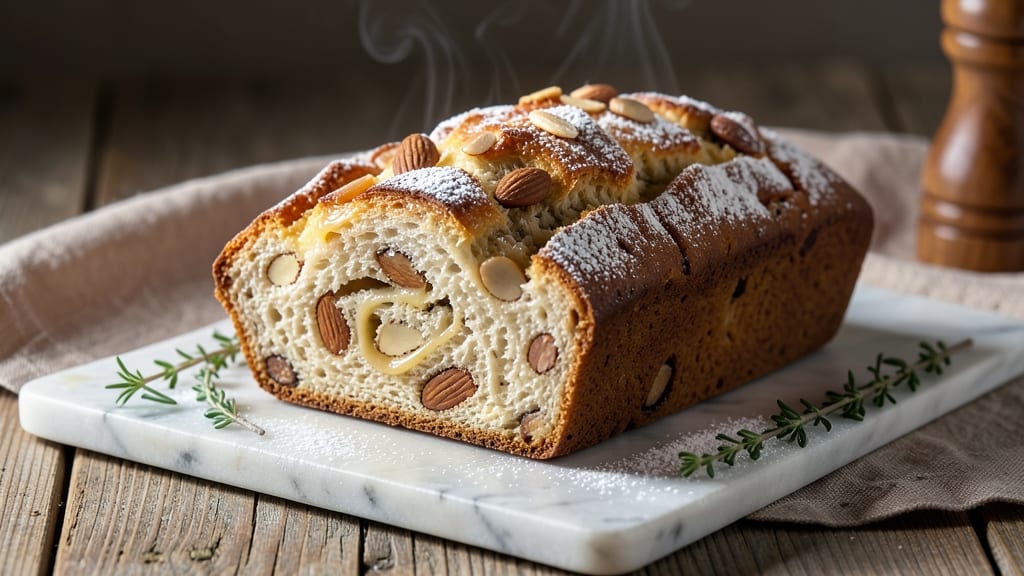
This almond-filled sweet bread recipe brings the elegance of Italian panettone to your kitchen with its vanilla-soaked layers and crunchy almond surprise. 🌟 The secret lies in a perfectly balanced dough—rich with butter and sugar—that encases a luscious almond filling, whether you prefer classic frangipane or marzipan.
I’ve refined this recipe over years, ensuring the bread rises beautifully, stays tender, and delivers that perfect almond crunch in every bite.
The dough begins with a foolproof brioche base, proofed just enough to create airy layers that soak up the vanilla syrup without losing structure. The almond filling, whether smooth marzipan or chopped almond paste, adds a luxurious texture that contrasts beautifully with the soft bread.
Baking at 350°F ensures a golden crust while keeping the interior moist—no dry, dense results here.
What sets this recipe apart is the vanilla syrup infusion, which transforms ordinary bread into something extraordinary. The syrup seeps into the layers during baking, creating a subtle sweetness that pairs perfectly with the nutty almond filling.
The result? A bread that’s restaurant-worthy but simple enough for a weeknight dessert or holiday centerpiece.
Whether you’re serving it warm with coffee or saving slices for days, this almond-filled sweet bread is a game-changer for any occasion. The technique is approachable, but the outcome feels special—like a taste of Italy in your own kitchen. Let’s get baking!
Ingredients for almond filled sweet bread
Buttery dough meets almond luxury—this list delivers restaurant-worthy layers with that signature crunchy surprise.
| Ingredient | Amount | Notes |
|---|---|---|
| All-Purpose Flour 🌾 | 4 cups | Sifted for light texture |
| Unsalted Butter 🧈 | 1 cup | Cold, cubed for dough |
| Granulated Sugar 🍚 | ½ cup | Superfine if available |
| Large Eggs 🥚 | 3 whole | Room temperature |
| Whole Milk 🥛 | ½ cup | Warm for activation |
| Active Dry Yeast 🍞 | 2 ¼ tsp | Instant yeast works too |
| Vanilla Extract 🌿 | 1 tbsp | Pure, not imitation |
| Salt 🧂 | ½ tsp | Diamond Crystal preferred |
| Almond Paste 🥜 | 1 ½ cups | Smooth or marzipan |
| Ground Almonds 🌰 | ½ cup | Toasted for depth |
| Powdered Sugar 🍚 | ¼ cup | For filling sweetness |
| Vanilla Bean Seeds 🍋 | 1 tbsp | Scraped from 1 pod |
| Granulated Sugar 🍚 | ¼ cup | For syrup infusion |
| Heavy Cream 🥛 | ¼ cup | For syrup richness |
| Egg Yolk 🥚 | 1 whole | For egg wash |
The butter makes or breaks this. Plugrá or Land O'Lakes work great, but avoid anything with additives. Cold cubes create the perfect flaky layers—don't let them melt before mixing. For the almond paste, Wilton or Marzipan House are my go-tos, but store-bought works if it's at least 50% almonds. The vanilla extract? Nielsen-Massey is worth the splurge—real Madagascar beans make all the difference. And that yeast? If it smells funky, toss it—fresh is non-negotiable here.
No almond paste? Blend toasted almonds with powdered sugar—it's a 1:1 swap, though texture will be slightly grainier. Short on vanilla extract? Vanilla bean paste works too, but you'll need twice the amount. The dough can take whole milk substitutes (like oat milk), but it might not rise as dramatically. For the syrup, vanilla bean seeds are optional but add that pro-level depth. And if you're feeling fancy, infuse the heavy cream with a splash of vanilla before adding it to the syrup—trust me on this.
Dough keeps 2 days wrapped in plastic in the fridge, or freeze for 3 months for make-ahead magic. The almond filling? Up to 5 days covered in the fridge—it won't spoil, just lose some moisture. Baked loaves stay fresh 3 days at room temp, but slice and freeze for up to 6 months. Pro tip: Wrap cooled loaves in parchment, then foil—they'll stay moist and ready for toasting anytime.
Why You'll Love This Recipe
- No-Knead Magic: I swear by this dough—just mix, let it rise, and fold once. The butter and milk create a tender crumb that’s effortlessly rich, without a single stretch of my arms.
- Almond Butter Bomb: That gooey almond filling? It’s the star. The toasted almonds in the butter-sugar mix caramelize just enough to make every bite taste like a hug from a Parisian bakery.
- Breakfast or Snack: Slice it warm for toast with jam or pack it cold for lunch—it holds up perfectly. Honestly, I’ve even used the leftovers to make French toast the next morning.
- Budget Baking Win: Flour, butter, sugar, eggs—these are pantry staples. The dough stretches far, and the filling costs pennies compared to store-bought pastries. Plus, it freezes like a dream.
Step-by-step instructions for almond-filled sweet bread
Here's how to create layers of vanilla-soaked dough with a crunchy almond surprise at the center.
👨🍳 Step 1: Prepare the Almond Filling and Yeast Mixture
In a small bowl, combine the 1.5 cups almond paste, 0.5 cup ground almonds, 0.25 cup powdered sugar, 1 tbsp vanilla bean seeds, and 0.25 cup granulated sugar. Mix until completely uniform—this will be your rich, nutty filling. Set aside. In a separate bowl, whisk together 0.5 cup warm whole milk with the 2.25 tsp active dry yeast and let sit for 5-10 minutes until foamy.
This activation step ensures your yeast is ready to work. If it doesn't foam, your yeast might be dead—start over with fresh yeast. The almond mixture should be smooth enough to pipe neatly between dough layers later. I like to press it through a fine-mesh sieve for an ultra-smooth texture.
👨🍳 Step 2: Make the Dough and First Layer
In a stand mixer fitted with the dough hook, combine 4 cups sifted all-purpose flour, 0.5 tsp salt, 0.5 cup granulated sugar, and 1 tbsp vanilla extract. Mix on low until combined. Add the 1 cup cold cubed unsalted butter and mix until the dough begins to come together. With the mixer running, gradually add the 3 whole large eggs and the yeast-milk mixture, mixing until fully incorporated.
Turn the dough out onto a lightly floured surface and knead gently for 2-3 minutes until smooth. Divide into 3 equal portions (about 10 oz each). Roll one portion into a 12-inch circle, about ⅛-inch thick. Spread ⅓ of the almond mixture evenly over the surface, leaving a ½-inch border around the edges.
🥘 Step 3: Assemble and Layer the Dough
Roll up the dough tightly from one edge, pinching the seam to seal. Place the log seam-side down on a parchment-lined baking sheet. Repeat with the remaining dough and almond mixture, creating 2 more identical logs. Arrange them side by side on the baking sheet, leaving 1 inch between each. Cover with a clean kitchen towel and let rise in a warm place for 1 hour or until doubled in size.
Here's the thing—don't over-rise the dough. You want gentle expansion, not ballooning. If your kitchen isn't warm enough, place the tray near a low oven heat (with the light on) to help it rise evenly. The logs should look plump but still maintain their shape.
🔥 Step 4: Bake to Golden Perfection
Preheat your oven to 350°F. In a small saucepan, combine 0.25 cup heavy cream, 0.25 cup granulated sugar, and 1 tbsp vanilla extract. Bring to a simmer over medium heat and cook for 3-4 minutes until slightly thickened. Brush this syrup over the risen dough logs. Whisk the 1 whole egg yolk with 1 tbsp water and brush this over the tops for a golden finish.
Bake for 30-35 minutes until the bread is golden brown and sounds hollow when tapped on the bottom. If the tops brown too quickly, tent with foil. The internal temperature should reach 190-195°F. Let cool on a wire rack for 15 minutes before slicing—this prevents the almond filling from oozing out.
🍽️ Step 5: Serve Warm for Maximum Flavor
Slice the bread into ½-inch thick pieces and serve warm. The layers should reveal that beautiful almond filling at each cut, offering a perfect balance of sweetness and crunch. The vanilla syrup adds moisture and depth, while the crispy exterior provides satisfying texture contrast. Store any leftovers in an airtight container for up to 3 days, though I doubt they'll last that long!
Pro Tips For Making Almond Filled Sweet Bread
- CHILL THE ALMOND FILLING: After mixing your almond paste (flour, sugar, ground almonds, butter, eggs), fold it into the dough cold—literally. Pop it in the fridge for 20 minutes before shaping. I learned this the hard way when the filling oozed out during baking, leaving a greasy mess instead of those perfect golden pockets. The cold butter stays firm, and the dough holds its shape like it’s supposed to.
- WEIGH YOUR FLOUR—NO EXCUSES: Dump that measuring cup. This dough is finicky, and volume measurements lead to either a gummy disaster or a dry brick. Use a kitchen scale for the flour—1 cup of all-purpose flour isn’t always 120g, and this recipe needs precision. My grandmother swore by this, and she was right: the texture is light and tender when the ratios are exact.
- STEAM THE FIRST 10 MINUTES: Bake your loaf on the middle rack with a tray of boiling water in the lower oven for the first 10 minutes. The steam keeps the crust from browning too fast while the center sets—critical for almond-filled bread, which can dry out if the outside hardens prematurely. After that, pull the tray and let the bread finish baking uncovered for a crisp top.
- SKIP THE EXTRA EGG WASH: Resist the urge to brush the loaf with an egg wash before baking—it’s unnecessary and makes the crust soggy. Instead, mix 1 tablespoon of whole milk with a pinch of sugar, then brush it on lightly after baking. This gives a subtle sheen without weighing down the texture. (Yes, even if you’re impatient like me, trust the process.)
Common mistakes when making perfect results
Overproofed Dough
One of the biggest mistakes is letting the dough rise too long. When the logs double in size and start to collapse or spread out, they’ve overproofed. This causes a dense, flat bread instead of the light, airy texture you want.
I’ve ruined several batches by leaving them out too long—trust the 1-hour guideline and check every 30 minutes if your kitchen is warm. A gentle touch test works: press your finger into the dough. If it springs back slowly, it’s ready. If it leaves a dent, it’s overproofed. 🌡️
Uneven Almond Filling
Smearing the almond mixture unevenly leads to some slices being almond-heavy while others are nearly empty. To avoid this, use a piping bag with a small round tip for precision. Spread the filling in a thin, even layer, leaving that ½-inch border around the edges.
If you’re rolling by hand, press the filling down gently with a spatula to create an even thickness. I’ve learned the hard way—uneven filling means uneven bites!
Skipping the Syrup Brush
Many home bakers forget to brush the vanilla syrup on the risen dough before baking. This step is crucial for that signature moisture and flavor. Without it, the bread turns out dry and lacks the rich, vanilla-kissed taste.
Simmer the syrup for 3-4 minutes until it thickens slightly—this ensures it sticks to the dough instead of pooling. I always make extra syrup because it’s worth the effort. 💫
Incorrect Baking Temperature
Baking at too high a temperature causes the outside to brown too quickly before the inside is fully cooked, while too low a temperature leaves the center underdone. Stick to 350°F and use an oven thermometer to verify accuracy.
If your oven runs hot, tent the bread with foil after 20 minutes to prevent over-browning. I’ve had to pull out undercooked loaves more times than I’d like—patience is key here!
Not Cooling Properly
Slicing the bread too soon after baking causes the almond filling to ooze out and the layers to collapse. Always let the bread cool on a wire rack for at least 15 minutes—this allows the structure to set.
If you’re impatient (like me), at least wait 10 minutes before slicing, but I promise the extra time is worth it for clean, intact layers. 🍞
Using Low-Quality Almond Paste
Cheap or heavily sweetened almond paste lacks the rich, nutty flavor and proper texture needed for this recipe. Stick to brands like Wilton or Marzipan House, which are at least 50% almonds. If you’re using store-bought, check the ingredients—some contain excessive sugar or fillers that alter the taste.
I’ve tried the budget options, and they just don’t compare to the real deal. Your almond filling deserves the best!
Nutrition facts
Frequently asked questions
Can I substitute almond paste with whole almonds?
Yes, but the texture will differ. For a similar result, blend 1 cup toasted whole almonds with ½ cup powdered sugar until finely ground. This creates a slightly grainier filling, but it still works beautifully. Just be sure to toast the almonds first for deeper flavor.
How do I store leftovers to keep them fresh?
Wrap cooled slices in plastic wrap, then place in an airtight container. They’ll stay fresh for 3 days at room temperature or 1 week in the fridge. For longer storage, freeze slices for up to 3 months—just thaw at room temperature before serving.
What’s the best way to reheat slices?
For a warm, gooey texture, wrap slices in foil and reheat at 300°F for 5-7 minutes. Or, toast in a skillet over medium-low heat for 1-2 minutes per side. Avoid the microwave—it makes the bread gummy instead of crisp.
Can I make this gluten-free?
Replace the all-purpose flour with a 1:1 gluten-free baking flour blend (like Bob’s Red Mill). Add ½ tsp xanthan gum to help bind the dough. The texture will be slightly denser, but the flavor remains rich. Use a gluten-free almond paste if possible.
Why did my bread turn out dense?
Overproofing or underbaking usually causes this. Check your yeast (it should foam in 5-10 minutes in warm milk). Also, ensure your oven is at 350°F—use an oven thermometer to confirm. If the bread collapses during baking, it may have risen too long.