
Side Dishes
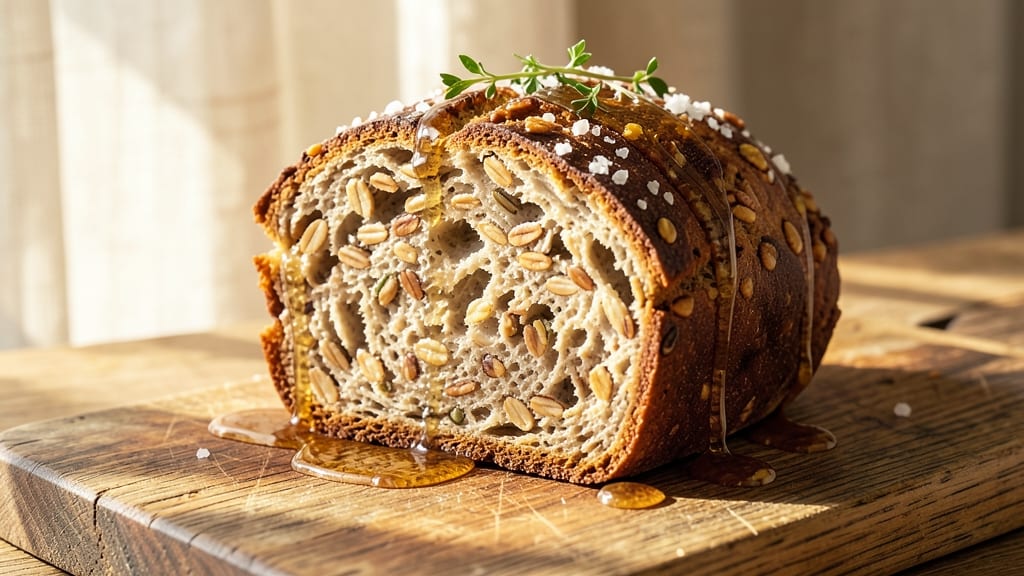
This 9-grain honey oat bread recipe delivers a harmonious blend of nutty crunch, open crumb texture, and sweet honey depth that elevates any meal. 🌟 The secret lies in the carefully balanced mix of whole grains and oats, which create a hearty yet tender loaf with a golden crust.
Perfect for sandwiches, toast, or serving alongside soups, this bread is packed with fiber and nutrients while offering a delightful contrast of textures and flavors.
The recipe combines nine different grains and oats for optimal nutrition, while raw honey adds natural sweetness and moisture, keeping the bread fresh longer. Unlike traditional bread recipes, this version requires no special equipment—just patience during the proofing stage.
The result is a loaf with a crisp exterior, soft interior, and a subtle sweetness that pairs beautifully with savory dishes or spreads like butter and jam.
What sets this bread apart is its versatility—use it for breakfast toast, dinner rolls, or even as a base for open-faced sandwiches. The grains contribute a satisfying crunch, while the honey infuses a gentle sweetness that enhances every bite.
Whether you're a home baker or a beginner, this recipe delivers restaurant-quality results with minimal effort.
For added texture, consider topping the loaf with seeds like sunflower or flax before baking. Store leftovers wrapped in a cloth to maintain freshness, or freeze slices for quick toast later. This bread is more than just a side—it's the star of your table.
Ingredients for 9 grain honey oat bread
Nine grains, one loaf—where nutty crunch meets honey-sweet perfection for sandwiches, toast, and soups alike.
| Ingredient | Amount | Notes |
|---|---|---|
| All-Purpose Flour 🌾 | 3 cups | For structure and binding |
| Old-Fashioned Rolled Oats 🍚 | 1 ½ cups | Steel-cut works too |
| Whole Wheat Flour 🌾 | 1 cup | For added fiber |
| Raw Honey 🍯 | ½ cup | Local preferred for flavor |
| Active Dry Yeast 🍞 | 2 ¼ tsp | Ensure freshness |
| Warm Water 💧 | 1 ¼ cups | 110°F for activation |
| Wild Rice 🌾 | ¼ cup | Uncooked, for texture |
| Quinoa 🌾 | ¼ cup | Uncooked, for protein |
| Millet 🌾 | ¼ cup | Uncooked, for nuttiness |
| Buckwheat 🌾 | ¼ cup | Uncooked, for earthiness |
| Amaranth 🌾 | ¼ cup | Uncooked, for crunch |
| Spelt 🌾 | ¼ cup | Uncooked, for mild flavor |
| Sunflower Seeds 🌻 | ¼ cup | For topping and texture |
| Flaxseeds 🌱 | ¼ cup | For topping and nutrition |
| Salt 🧂 | 2 tsp | Kosher preferred |
| Olive Oil 🫒 | ¼ cup | For dough softness |
The grains are the heart of this bread, so buy them in bulk for freshness—Whole Foods or Bob's Red Mill carry all nine. Toast the grains lightly before adding to the dough for deeper flavor (just 5 minutes in a dry pan). The oats? Old-fashioned rolled gives the best texture—steel-cut will make your bread denser. Honey should be raw and unfiltered for that golden depth. Local honey from farmers markets adds unique floral notes, but any quality store-bought works too. The yeast needs to be fresh—test it by dropping a pinch in warm water; if it bubbles within 5 minutes, it's good to go.
No wild rice? Substitute with extra quinoa or brown rice—just reduce the total grain amount by 0.25 cup to keep the dough manageable. Short on buckwheat? Swap with more millet or amaranth. The seeds can be omitted, but they add that satisfying crunch—Trader Joe's sells pre-portioned seed mixes if you're short on time. For the honey, agave nectar works in a pinch, though it lacks the floral complexity. The olive oil? Avocado oil is a neutral alternative if you're avoiding olive's strong flavor. And if your dough feels too sticky? Add 1 tbsp more flour—this bread forgives minor adjustments.
This loaf keeps beautifully wrapped in a clean kitchen towel for 3-4 days at room temperature. For longer storage, freeze slices wrapped in parchment—toast straight from frozen for crispy results. The seeds on top? Save some for garnishing toast later. The bread's peak freshness is within the first 2 days, but even after that, it reheats wonderfully in a 350°F oven for 5-7 minutes. Double the recipe if you're feeding a crowd—the dough just needs more time to rise.
Why You'll Love This Recipe
- No-Knead Nightmare Solved: I swear by this recipe when I’m too tired to fuss—just mix, let it rise overnight, and bake while I’m still in bed. The rolled oats handle all the texture work for you, so no punchy arms or sticky counters.
- Honey’s Secret Weapon: That raw honey isn’t just sweet—it caramelizes into a sticky, golden crust that cracks open like a bakery loaf. Honestly, I’ve caught myself sneaking slices straight from the pan, toasted.
- Breakfast to Brunch: Slather it with peanut butter for a grab-and-go morning or serve warm with jam for weekend brunch. My kids even ask for it at dinner when I slice it thin for open-faced sandwiches—no one turns down this crowd-pleaser.
- Budget-Friendly Staple: Whole wheat flour and oats stretch my grocery budget, and a single loaf lasts my family five days. I freeze slices for quick toast, and the dough’s simplicity means I’m not wasting money on specialty ingredients.
Step-by-step instructions for 9-Grain honey oat bread
Here's how to craft a loaf with perfect open crumb and nutty depth—every step matters.
👨🍳 Step 1: Prepare the Grains and Hydrate
In a large bowl, combine the 0.25 cup wild rice, 0.25 cup quinoa, 0.25 cup millet, 0.25 cup buckwheat, 0.25 cup amaranth, and 0.25 cup spelt. Add 1.25 cups warm water (about 110°F) and let soak for 30 minutes. This hydrates the grains and kickstarts their flavor infusion—you'll notice they soften and plump slightly, releasing nutty aromas.
While soaking, toast the 1.5 cups old-fashioned rolled oats in a dry skillet over medium heat for 3-4 minutes until golden brown. This enhances their caramelized flavor and prevents gummy texture. Let cool completely before adding to the dough later.
🍳 Step 2: Mix the Dough and Incorporate Honey
In the bowl of a stand mixer fitted with the dough hook, combine the 3 cups all-purpose flour, 1 cup whole wheat flour, 2.25 tsp active dry yeast, and 2 tsp salt. Mix on low speed for 30 seconds to distribute the ingredients evenly.
Add the hydrated grains (with their soaking liquid), 0.5 cup raw honey, and 0.25 cup olive oil to the flour mixture. Mix on low speed for 2 minutes, then increase to medium speed for 5 minutes until the dough comes together and pulls away from the sides of the bowl. The dough should be slightly sticky but manageable—add 1 tablespoon flour if needed, but don't overdo it.
🥘 Step 3: Knead for Optimal Gluten Development
Continue kneading on medium speed for 8-10 minutes until the dough becomes smooth and elastic. You'll know it's ready when it forms a "windowpane" when stretched—press your fingers gently into the dough and pull upward; if it thins without tearing, it's perfect.
This kneading step is critical for developing gluten, which gives the bread its open crumb structure. If the dough feels too warm (over 80°F), let it rest for 5 minutes before continuing. Shape the dough into a ball, place it in a lightly oiled bowl, cover with a damp towel, and let rise in a warm place for 1-1.5 hours or until doubled in size.
🔥 Step 4: Shape and Proof the Loaf
Punch down the risen dough and turn it out onto a lightly floured surface. Divide the dough into 8 equal portions (about 6 ounces each). Roll each portion into a 12-inch log, then coil each log into a spiral, tucking the ends underneath. Place the spirals seam-side down in a 9x5-inch loaf pan lined with parchment paper.
Cover the loaf pan with a damp towel and let proof for 30-45 minutes until the dough rises 1-2 inches above the pan. The surface should look slightly domed and feel springy when pressed gently with a finger. Preheat your oven to 375°F while the dough proofs—this ensures even baking.
⏰ Step 5: Bake to Golden Perfection
Score the top of the loaf with a sharp knife in a crisscross pattern (about ¼-inch deep) to allow steam to escape and create an even rise. Sprinkle the 0.25 cup sunflower seeds and 0.25 cup flaxseeds evenly over the top for texture and nutrition.
Bake for 35-40 minutes until the bread is deep golden brown and sounds hollow when tapped on the bottom. If the top browns too quickly, tent loosely with foil after 20 minutes to prevent over-browning. Remove from the oven and let cool in the pan for 10 minutes, then transfer to a wire rack to cool completely before slicing.
Pro Tips For Making 9 Grain Honey Oat Bread
- Toast Your Oats First: I learned this the hard way—skipping this step makes your bread dense and gummy. Pulse the old-fashioned rolled oats in a food processor for 10-15 seconds, then spread them on a baking sheet and toast in a 350°F oven for 8-10 minutes until golden and fragrant. This caramelizes the oats and cuts down on dough stickiness.
- Bloom Yeast with Warm Honey: Mix the active dry yeast with the raw honey and warm water (110°F) first—let it sit for 5 minutes until frothy. The honey’s natural sugars feed the yeast better than plain water, and this step guarantees your bread rises properly. (Yes, even if you’re impatient like me.)
- Don’t Over-Knead the Dough: The whole wheat and oats make this dough tougher than all-purpose flour dough. Knead just until the ingredients come together—about 5-6 minutes—then let it rest. Overworking it develops gluten too much, and your bread will turn out chewy instead of tender.
- Use a Digital Thermometer: The crust on this bread is tricky—it needs to be deep golden but not burned. Pull it out when the internal temperature hits 190°F, and the crust is a rich amber color. I used to guess, and now I never overbake. (Your future self will thank you.)
Common mistakes when making this recipe
Over-Kneading Risks
I’ve seen beginners over-knead this dough, thinking more time means better gluten development—but too much can turn your bread dense and tough. Stop kneading when the dough forms a "windowpane" (stretches thin without tearing). Over-kneading also breaks down the delicate grains, making them mushy instead of crunchy. 💡
Skipping Grain Soaking
Don’t skip soaking the grains! Hydrating them first ensures even flavor infusion and prevents a gummy texture. I once forgot and ended up with a loaf that tasted bland and chewy. Soak for 30 minutes—no more, or the dough will get too wet.
Yeast Temperature Mistakes
Using water that’s too hot (over 120°F) or too cold (under 100°F) can kill your yeast, leaving you with flat bread. Test the water with your wrist—it should feel warm but not scalding.
If your dough doesn’t rise after 1 hour, your yeast might be dead.
Underproofing the Dough
A common mistake is rushing the proofing stage. Underproofed dough bakes up dense and heavy. Let the dough rise until it’s doubled in size and springs back when poked. Patience here makes all the difference—don’t cut corners!
Ignoring the Honey’s Role
Honey isn’t just for sweetness—it’s also a natural dough tenderizer. Using agave or sugar instead can make the bread drier. Raw honey’s moisture keeps the crumb soft, so don’t substitute unless you’re willing to adjust hydration.
Overcrowding the Pan
If you’re making multiple loaves, resist the urge to cram them into one pan. Overcrowding leads to uneven baking and steam buildup, which can make the crust soggy. Use separate pans or bake in batches for even results. 🔥
Nutrition facts
Frequently asked questions
Why does this bread use so many different grains?
Each grain contributes unique texture and nutrition—wild rice adds chewiness, quinoa boosts protein, and buckwheat provides earthy depth. The mix creates that signature nutty crunch while balancing the honey's sweetness. For a simpler version, reduce to 3-4 grains, but you'll lose some complexity.
Can I make this bread without a stand mixer?
Mix by hand in a large bowl, then knead for 10-12 minutes by hand on a floured surface until smooth. The dough will be sticky, so wet your hands occasionally. Just be prepared for more elbow grease—this bread benefits from thorough gluten development.
How do I store leftover slices without them drying out?
Wrap cooled slices individually in parchment paper, then store in an airtight container with a slice of bread or damp paper towel. For longer storage (1 week), freeze slices wrapped in parchment and plastic wrap. Toast straight from frozen for maximum crispness.
What's the best way to reheat this bread?
For crispy toast, warm slices in a 350°F oven for 5-7 minutes on a wire rack. To revive stale bread, wrap in foil and warm for 10 minutes. Avoid microwaving—it makes the crust rubbery. The honey keeps the interior moist even after cooling.
Can I substitute whole grains for refined flour?
Yes, but adjust carefully. Replace up to 1 cup all-purpose flour with whole wheat or spelt, but no more than 50% total or the dough may become too dense. For each cup of whole grain flour, add 1 tsp extra flour to compensate for its higher absorption.